Mental Health for First Responders: Why Help May be Hard to Reach, and What's Changing

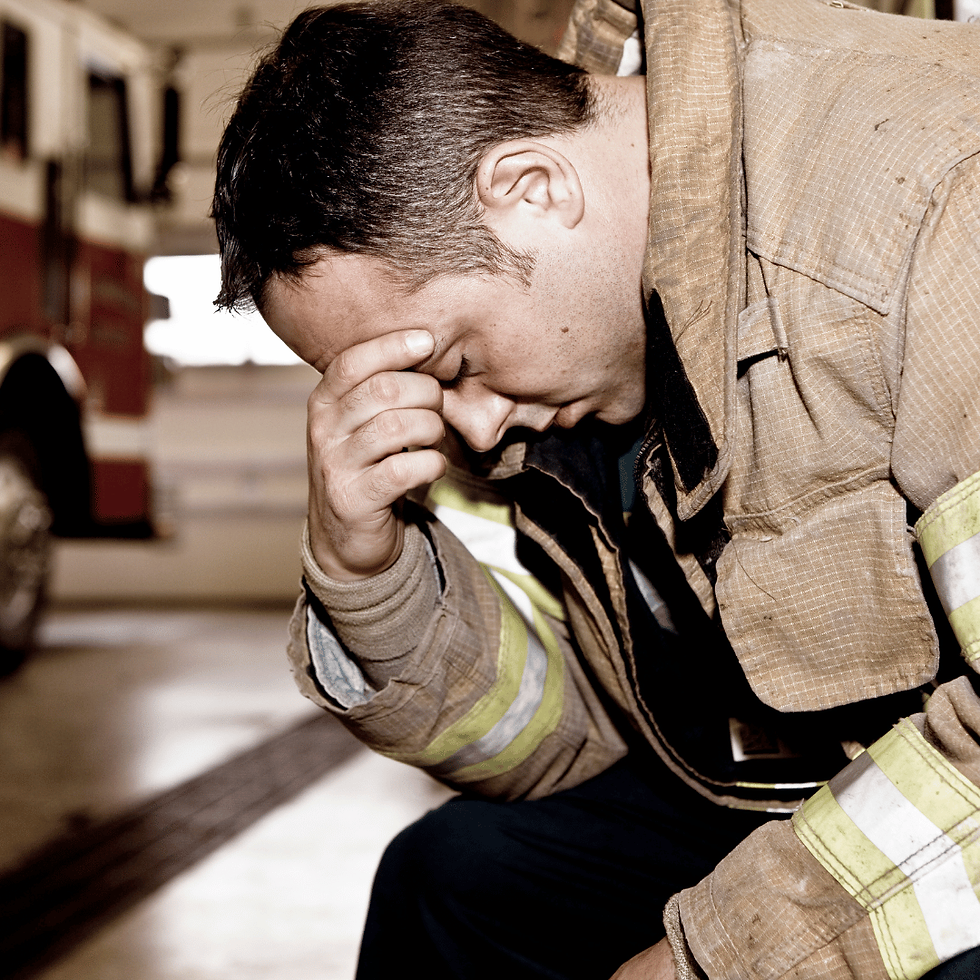
When researchers pooled the data on mental health for first responders, they found that about one in three carries a stigma about getting help, while about one in eleven runs into a concrete barrier that stops them from accessing care. Those two numbers, drawn from a systematic review of studies across firefighters, police, and EMS, explain a gap that has frustrated this field for years: the distance between how many first responders are struggling and how few of them walk through a clinician's door. The struggle is well documented. The reasons help so often does not happen are less talked about, and they are where the real work sits.
For LA County firefighters, this is not an abstract question. It shapes whether a firefighter who needs support actually gets it, and it shapes how long a problem is allowed to grow before anyone names it. The prevalence picture, the rates of PTSD, depression, and burnout across the fire service, is covered in our post. This post is about something different. It is about what stands in the way once the need is already there.
The two walls between a first responder and care
The research draws a useful line between two separate obstacles, and they do not get in the way in the same fashion.
The first is stigma, the belief that asking for help carries a cost to how you are seen. In the pooled data, about 33 percent of first responders endorsed stigma items, making it by far the more common of the two. The most frequently named concerns were fears about confidentiality and worry about a negative impact on their career.
The second wall is more practical. Barriers to care describe the logistical obstacles that block access even when someone is ready to try. Roughly 9 percent of first responders endorsed these. The most common were scheduling problems and simply not knowing where to get help. These are quieter obstacles, easy to overlook, and easy to mistake for a lack of motivation when the truth is closer to a lack of a clear door to walk through.
Understanding which wall a person is facing matters, because they call for different responses. One is about culture and perception. The other is about logistics and access. A department can knock down the second while the first is still standing, and a firefighter can clear the first only to find the second waiting.
How stigma works inside the fire service
Researchers describe stigma as something that moves in stages rather than landing all at once. First, a symptom shows up and gets read as a sign of mental illness. Then that sign triggers a stereotype, the idea that someone struggling is weak or unreliable. Finally, the person on the receiving end starts to believe the stereotype about themselves and feels the shame that comes with it.
That last step is what researchers call self stigma, and it is distinct from the public stigma a person picks up from the world around them. There is also a third form, label avoidance, where someone steers clear of acknowledging symptoms or seeking services specifically to dodge the diagnostic label and everything they fear comes with it.
The fire service turns each of these up. A culture built on self-reliance and composure under pressure, the exact traits that make the job possible, also raises the cost of admitting something is wrong. The review notes that first responder culture shares key features with military culture: pre-employment mental health screening, a workforce that is heavily male, and a deep premium placed on handling obstacles alone. Those features are strengths in the field. They are also part of why a firefighter might carry a problem in silence rather than risk being seen as the one who could not hold steady.
The barriers no one schedules around
Even when a firefighter clears the stigma and decides to seek help, the practical wall can stop them cold. The two barriers the research flagged most often, scheduling and not knowing where to go, hit this profession with particular force.
Shift work is built into the job, and it does not bend to a clinician's nine-to-five calendar. A firefighter coming off a 24-hour shift, or rotating through a schedule that changes week to week, faces a real logistical problem getting to an appointment that civilian patients schedule without a second thought.
Then there is the question of where to go. Across the field, the research points to not knowing where to find help as one of the most common barriers, and finding a provider who understands the fire service, who knows what a career of cumulative exposure does to a person, is harder in many parts of the country than finding general care. LA County firefighters are fortunate here, with established peer support and access to mental health specialists who understand the job. The barrier the research describes is real for the profession as a whole, which is part of why the access that does exist is worth knowing about and using.
Confidentiality sits at the intersection of both walls. The fear named most often on the stigma side, worry about who finds out, becomes a practical barrier in a tight professional community where people know each other and word travels. When a firefighter cannot trust that seeking help stays private, the decision to seek it at all gets harder, no matter how ready they are.
What's changing in mental health for first responders
There is a finding in the research that raises the stakes on all of this. The review found indications that stigma and barriers cluster more heavily among the first responders who are already struggling with mental health problems. The people who most need to get through the wall are, on average, the ones facing the highest wall. Left alone, that pattern lets a treatable problem harden into a chronic one, which is exactly why lowering the barriers early carries so much weight.
The encouraging part is that the walls are coming down. Confidentiality protections, peer support built and staffed by firefighters who have lived the job, and a steady cultural shift toward treating help-seeking as a sign of strength are changing what was possible even a decade ago. The home front matters here too, since the people closest to a firefighter are often the first to notice when something is off, a dynamic we cover in our post. None of this erases stigma overnight. But it chips away at the belief that asking is weakness, and it replaces it with something truer: that the firefighters who reach out are doing the harder, braver thing.
That shift matters most because of what sits behind the wall. A career in the fire service is built on cumulative exposure, thousands of calls compounding over decades in ways the body and mind absorb quietly, a process we break down in our post. The sooner a firefighter can get past the obstacles to care, the less that exposure is left to do its work unattended.
Standing behind the firefighters who serve
The Los Angeles County Firefighters Welfare Fund exists for the firefighters who carry this work and the families who carry it alongside them. The fund is an independent 501(c)(3) and is not affiliated with the LA County Fire Department. We do not provide clinical care but we do stand firmly in the corner of a community that gives so much, offering direct support in the moments when life turns heavy, and helping make sure the people behind the badge are met with the recognition they have earned.
If the firefighters who protect LA County matter to you, we would be glad to have you with us. Follow us on Instagram and Facebook, and if you are moved to give, your donation goes directly to the firefighters and families who need it most.